Dinosaur fossils & 3D skeletons › Therizinosaurus
Therizinosaurus Fossil & 3D Skeleton
Therizinosaurus cheloniformis
- Age
- Cretaceous, about 69.1 million years ago
- Found in
- Mongolia
- Length
- 10.8 m
- Height
- 5.9 m
- Group
- Therizinosaurus relatives
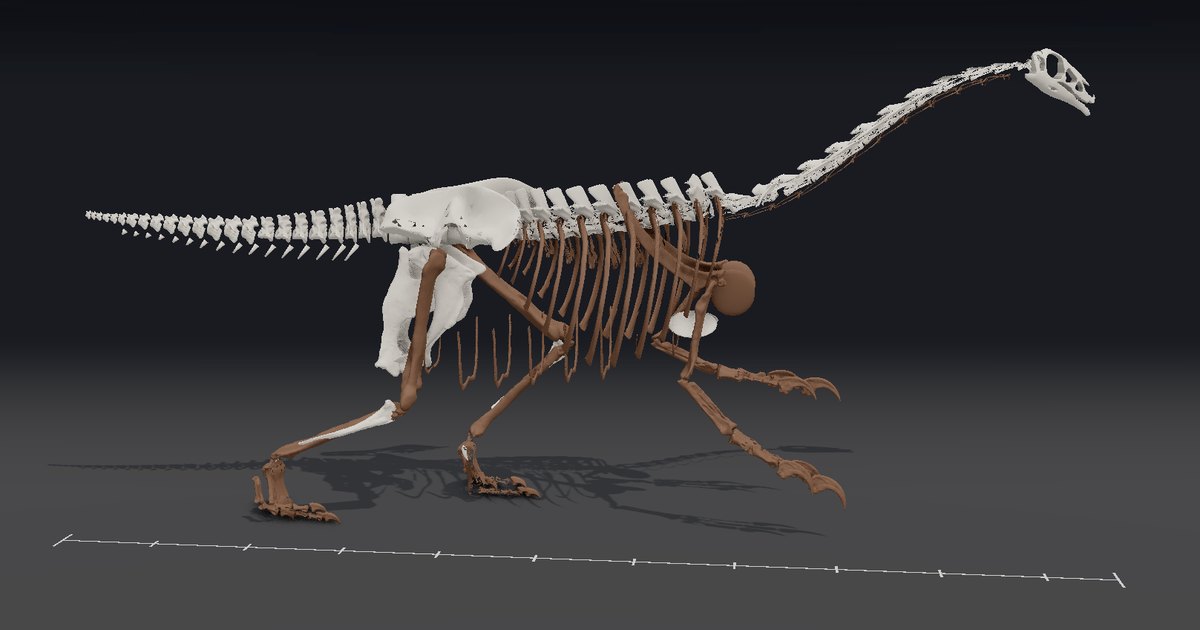
How this 3D skeleton was made
This 3D model is a reconstruction. Most bone shapes (177 of 225) are borrowed from close relatives and fitted to this species' size and body proportions. The bone shapes are not the actual shapes of this species' fossils. 48 are estimated.
From this species 0Borrowed from relatives 177Estimated 48
Bones known from fossils
136 of 225 bones are known from fossils. 89 are missing and filled in.
Known 136Filled in 89No record 0
Tap a bone on the 3D page to see where each bone shape came from.
Sources
- 3D Skeleton: Borrowed bone shapes from the template 'Nothronychus' (T9). Because there are no actual measurements of body proportions for this species, its size was determined from a humerus length of 760 mm in PBDB, Barsbold 1976 (specimen (PBDB, Barsbold 1976)) from the PBDB (Paleobiology Database, CC BY 4.0), which gave an estimated femur length of 1747 mm (±53%) using a formula for related species. Other body proportions remain those of the template. The shape of each bone belongs to the template species, not this species. Source of template skeleton: 3D Skeleton: Assembled on this site. Bone shapes directly used life-sized 3D bone models provided in Hedrick et al. 2015 PLOS ONE (CC BY 4.0). For bones with 3D scans from specimen MSM P2117 of this species (humerus, ulna, scapula, ischium, tibia, fibula, metatarsal I, pedal ungual, gastralia, and caudal vertebrae), those were used; missing bones (femur, pubis, radius, manual ungual, and anterior caudal vertebrae) used the related N. graffPose (2026-09-30): Used bone orientations read directly from pixel coordinates in Pacheco et al. 2019 PeerJ (CC BY) Fig. 1H (skeletal reconstruction and walking pose of Gnathovorax) (front leg: femur 50° forward, tibia 46° backward, metatarsus 24° forward; back leg: femur 12° backward, tibia 67° backward, metatarsus 16° forward; arm: humerus 40° backward, forearm 66° forward). Since only one arm is drawn in the figure, the far arm is slightly swung forward (estimated). The ground level of both soles was aligned by adjusting the angle of the hind leg's tibia (or metatarsus if needed). Lateral neck bending and tail curvature are estimated (the figure only shows a lateral view). Instead of a walking diagram of this species itself, bone orientations from a related species with the same walking style were applied. The neck is turned slightly to the side, and the tail is curved laterally (the degree of orientation is estimated; the figure is lateral view only).
- Known bones: Per-species bone table from Cashmore, Butler & Maidment (2021) (Zenodo 5029952, CC0). Because vertebrae are recorded as "at least one found" per section (neck, back, hips, and tail), bones within each section share the same color.
More fossils & 3D skeletons
TyrannosaurusTriceratopsMosasaurusSpinosaurusPteranodonStegosaurusBrachiosaurusGiganotosaurusArchaeopteryxAnkylosaurusAllosaurusBaryonyxVelociraptorDeinonychusParasaurolophusPachycephalosaurusCarnotaurusQuetzalcoatlusDeinosuchusYutyrannusBrontosaurusOviraptorCeratosaurusIguanodonPlesiosaurusArgentinosaurusDiplodocusIchthyosaurusDilophosaurusFutabasaurusDimetrodonFukuiraptorSarcosuchusElasmosaurusEdmontosaurusFukuisaurusKamuysaurusMicroraptorCompsognathusApatosaurusRhamphorhynchusMamenchisaurusDeinocheirusLiopleurodonKronosaurusGallimimusProtoceratopsEoraptorHeterodontosaurus