Dinosaur fossils & 3D skeletons › Ceratosaurus
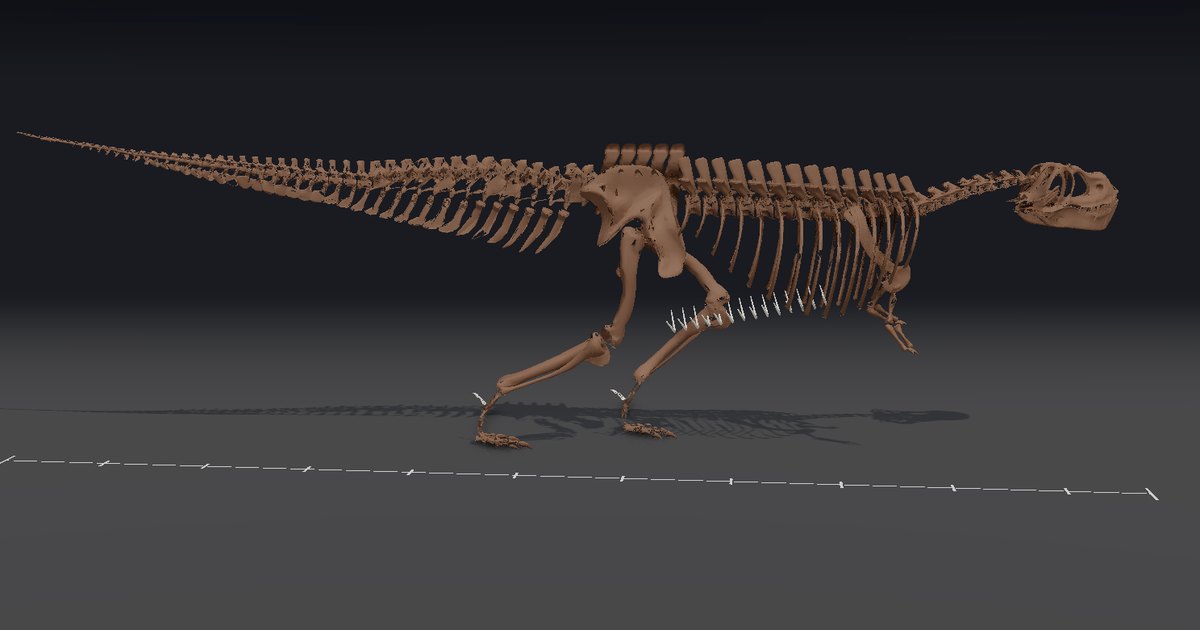
Ceratosaurus Fossil & 3D Skeleton
Ceratosaurus nasicornis
- Age
- Jurassic, about 148.9 million years ago
- Found in
- United States
- Length
- 5.5 m
- Height
- 1.8 m
- Group
- Ceratosaur relatives
How this 3D skeleton was made
This 3D model is a reconstruction. Most bone shapes (168 of 226) are borrowed from close relatives and fitted to this species' size and body proportions. The bone shapes are not the actual shapes of this species' fossils. 29 bones were shaped from photos or figures of this species' own fossils. 29 are estimated.
From this species 29Borrowed from relatives 168Estimated 29
Bones known from fossils
194 of 226 bones are known from fossils. 32 are missing and filled in.
Known 194Filled in 32No record 0
Tap a bone on the 3D page to see where each bone shape came from.
Sources
- 3D Skeleton: Created on this site. Bone shapes were traced from the outlines of plates and illustrations of type specimen USNM 4735 in Gilmore 1920 (Bulletin 110, United States National Museum; no copyright; skull, neck vertebrae, tail vertebrae, pelvis, scapula, femur, tibia, metatarsals), and sizes were matched to the measurement tables in the same book. Since there are no usable illustrations of this species for back vertebrae, tail tip, and humerus, shapes were borrowed from the Allosaurus illustrations in the same book and matched to the length and height in the Ceratosaurus table (displayed when touching the bone). Pose is a standard theropod standing posture (angles set by this site). Pose (2026-09-30): Bone orientations were read pixel-by-pixel directly from Figure 1H of Pacheco et al. 2019 PeerJ (CC BY; full skeletal reconstruction of Gnathovorax walking) (front leg: thigh 50 degrees forward, shin 46 degrees back, instep 24 degrees forward; back leg: thigh 12 degrees back, shin 67 degrees back, instep 16 degrees forward; arm: upper arm 40 degrees back, forearm 66 degrees forward). Because the figure only depicts one arm, the far arm was swung slightly forward (estimated). The soles of both feet were aligned to the ground by adjusting the angle of the back leg's shin (and instep if needed). The sideways turn of the neck and sideways curve of the tail are estimated (the figure is side view only). Rather than a walking diagram of this species itself, bone orientations from a relative with a similar gait were applied. The neck was turned slightly to the side, and the tail curved sideways (the degree of turn is estimated; the figure shows only a side view).
- Known bones: Species-by-species bone table from Cashmore, Butler & Maidment (2021) (Zenodo 5029952, CC0)
More fossils & 3D skeletons
TyrannosaurusTriceratopsMosasaurusSpinosaurusPteranodonStegosaurusBrachiosaurusGiganotosaurusArchaeopteryxAnkylosaurusTherizinosaurusAllosaurusBaryonyxVelociraptorDeinonychusParasaurolophusPachycephalosaurusCarnotaurusQuetzalcoatlusDeinosuchusYutyrannusBrontosaurusOviraptorIguanodonPlesiosaurusArgentinosaurusDiplodocusIchthyosaurusDilophosaurusFutabasaurusDimetrodonFukuiraptorSarcosuchusElasmosaurusEdmontosaurusFukuisaurusKamuysaurusMicroraptorCompsognathusApatosaurusRhamphorhynchusMamenchisaurusDeinocheirusLiopleurodonKronosaurusGallimimusProtoceratopsEoraptorHeterodontosaurus