Dinosaur fossils & 3D skeletons › Velociraptor
Velociraptor Fossil & 3D Skeleton
Velociraptor mongoliensis
- Age
- Cretaceous, about 77.9 million years ago
- Found in
- Mongolia
- Length
- 1.7 m
- Height
- 0.6 m
- Estimated mass
- about 13 kg
- Group
- Dromaeosaurids
How this 3D skeleton was made
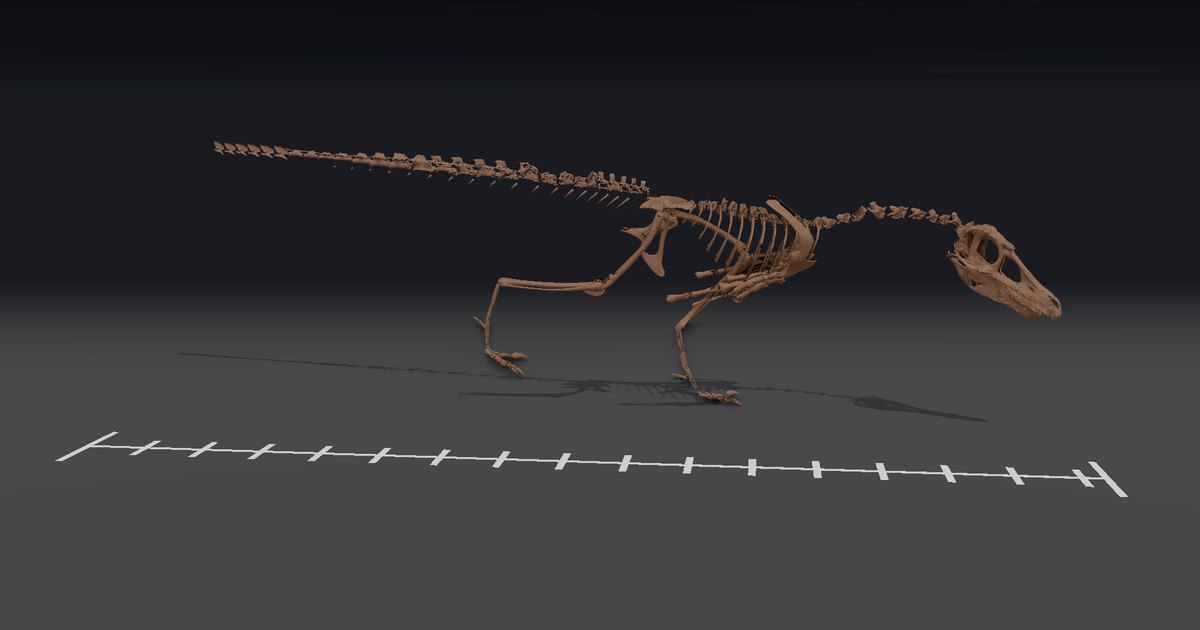
This 3D model is a reconstruction. Most bone shapes (126 of 172) are borrowed from close relatives and fitted to this species' size and body proportions. The bone shapes are not the actual shapes of this species' fossils. 28 bones were shaped from photos or figures of this species' own fossils. 18 are estimated.
From this species 28Borrowed from relatives 126Estimated 18
Bones known from fossils
172 of 172 bones are known from fossils.
Known 172Filled in 0No record 0
Tap a bone on the 3D page to see where each bone shape came from.
Sources
- 3D Skeleton: Borrowed bone shapes from the template 'Buitreraptor' (T12). The lengths of 10 body segments (head, neck, trunk, tail, humerus, forearm, hand, thigh, shin, and foot) were scaled individually to match actual measurements from the Velociraptor 3D skeletal model (specimen IGM 100/986) in Dempsey et al. (2025) Biol Rev doi:10.1111/brv.70026 (CC BY 4.0). The shape of each bone belongs to the template species, not this species. Source of template skeleton: 3D Skeleton: Created on this site. Bone shapes were traced from outlines in photos (lateral, anterior, etc.) of holotype MPCA 245 and other specimens, with sizes matched to scale bars and measurement tables in Gianechini et al. 2018 PeerJ (CC BY 4.0). Articulated vertebrae were segmented individually based on table length proportions. Although a skull is known for this species, because the descriptive paper is not freely usable, shape and length Pose (2026-09-30): Referencing the foot placement in Pacheco et al. 2019 PeerJ Fig. 1H (Gnathovorax), an estimated pose was created stepping forward with hips lowered and head turned to the right. Stride, joint angles, head and neck orientation, and tail swing are display estimates suited for this model, not reproductions of measured motion or speed for this species. An additional 10° forward trunk tilt (positive is nose-down) is also estimated. It depicts a mid-stride transition with the left foot supporting and the right hindlimb swung an additional 18° backward at the hip (estimated). Distinguishing between supporting and swinging legs is an exhibition estimate, not a reproduction of walking speed or running ability. Instead of a walking diagram of this species itself, bone orientations from a related species with the same walking style were applied.
- Known bones: Per-species bone table from Cashmore, Butler & Maidment (2021) (Zenodo 5029952, CC0). Because vertebrae are recorded as "at least one found" per section (neck, back, hips, and tail), bones within each section share the same color.
More fossils & 3D skeletons
TyrannosaurusTriceratopsMosasaurusSpinosaurusPteranodonStegosaurusBrachiosaurusGiganotosaurusArchaeopteryxAnkylosaurusTherizinosaurusAllosaurusBaryonyxDeinonychusParasaurolophusPachycephalosaurusCarnotaurusQuetzalcoatlusDeinosuchusYutyrannusBrontosaurusOviraptorCeratosaurusIguanodonPlesiosaurusArgentinosaurusDiplodocusIchthyosaurusDilophosaurusFutabasaurusDimetrodonFukuiraptorSarcosuchusElasmosaurusEdmontosaurusFukuisaurusKamuysaurusMicroraptorCompsognathusApatosaurusRhamphorhynchusMamenchisaurusDeinocheirusLiopleurodonKronosaurusGallimimusProtoceratopsEoraptorHeterodontosaurus