Dinosaur fossils & 3D skeletons › Dilophosaurus
Dilophosaurus Fossil & 3D Skeleton
Dilophosaurus wetherilli
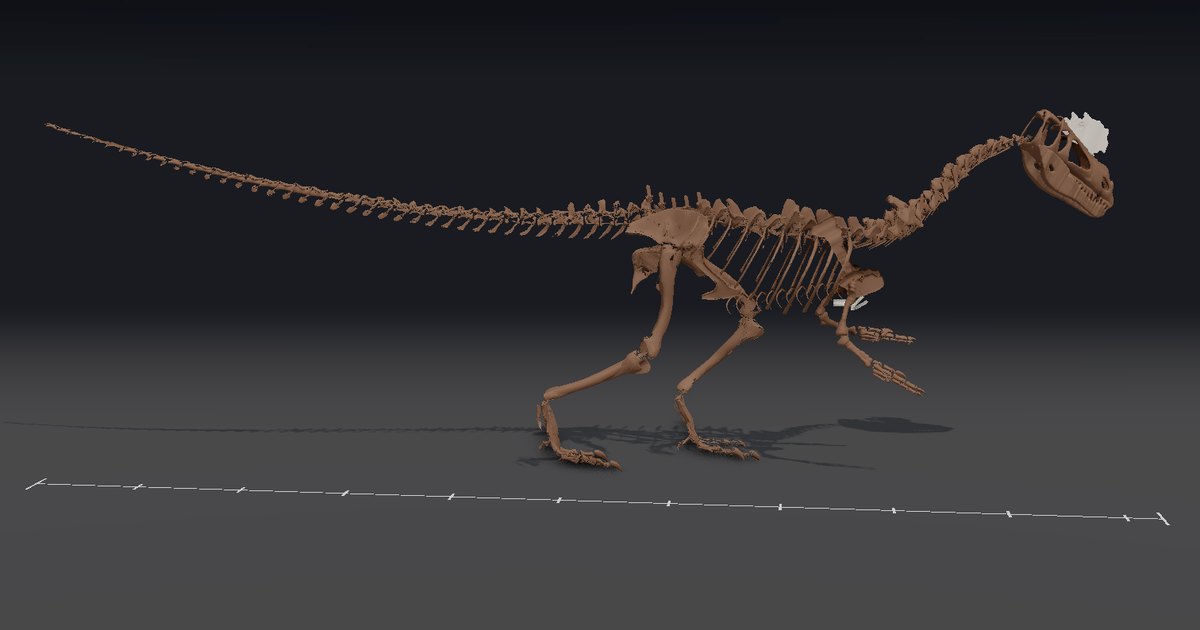
- Age
- Jurassic, about 191.8 million years ago
- Found in
- United States
- Length
- 7.0 m
- Height
- 2.6 m
- Group
- An early carnivorous dinosaur
How this 3D skeleton was made
38% of bone shapes (103 of 271) were built from photos or figures of this species' own fossils; the rest are 111 borrowed from close relatives and 57 estimated.
From this species 103Borrowed from relatives 111Estimated 57
Bones known from fossils
266 of 271 bones are known from fossils. 5 are missing and filled in.
Known 266Filled in 5No record 0
Tap a bone on the 3D page to see where each bone shape came from.
Sources
- [Sized to commonly cited body length] While this skeleton model has a total length of 5.18 m, this differs greatly from the commonly cited body length (7–7 m; no source cited in the article; from the English Wikipedia article "Dilophosaurus"), so for display, the entire skeleton was scaled by 1.35 times to 7 m (because the underlying specimen and drawing were from a small individual). 3D skeleton: Created on this site. The shapes of the discovered bones were traced from contours in bone photographs (1–3 views: lateral, anterior, dorsal, etc.) in Marsh & Rowe (2020) J. Paleontology 94(S78) (CC BY 4.0), and lengths were matched to the measurement tables in the same paper (holotype UCMP 37302, Zenodo 4957589, CC0). The skull and lower jaw were scaled from photographs of UCMP 77270 to match the holotype size using a ratio based on 4 bones (0.93). Digit bones, some vertebrae, and chevrons borrowed shapes from related bones, while ribs and gastralia were estimated in shape and length (shown when touching the bones). The pose is a generic standing pose established on this site (2026-09-30): bone orientations were read pixel-by-pixel directly from Pacheco et al. 2019 PeerJ (CC BY) Fig. 1H (full skeletal reconstruction of Gnathovorax, walking pose) (front leg: femur 50° forward, shin 46° backward, metatarsus 24° forward; back leg: femur 12° backward, shin 67° backward, metatarsus 16° forward; arm: humerus 40° backward, forearm 66° forward). Since the diagram only depicts 1 arm, the far arm was swung slightly forward (estimated). The heights of the soles of the 2 feet were aligned by adjusting the angle of the hind leg's shin (or metatarsus if needed). Lateral turning of the neck and lateral bending of the tail are estimated (the diagram is lateral view only). Rather than a walking diagram of this species itself, bone orientations from a relative sharing the same gait were applied. The neck was turned slightly sideways, and the tail was bent sideways (magnitude of angle is estimated; the diagram is lateral view only).
- Known bones: Species-by-species bone table from Cashmore, Butler & Maidment (2021) (Zenodo 5029952, CC0). The furcula and sternal plates are also noted as "absent in all specimens" in the text of Marsh & Rowe (2020).
More fossils & 3D skeletons
TyrannosaurusTriceratopsMosasaurusSpinosaurusPteranodonStegosaurusBrachiosaurusGiganotosaurusArchaeopteryxAnkylosaurusTherizinosaurusAllosaurusBaryonyxVelociraptorDeinonychusParasaurolophusPachycephalosaurusCarnotaurusQuetzalcoatlusDeinosuchusYutyrannusBrontosaurusOviraptorCeratosaurusIguanodonPlesiosaurusArgentinosaurusDiplodocusIchthyosaurusFutabasaurusDimetrodonFukuiraptorSarcosuchusElasmosaurusEdmontosaurusFukuisaurusKamuysaurusMicroraptorCompsognathusApatosaurusRhamphorhynchusMamenchisaurusDeinocheirusLiopleurodonKronosaurusGallimimusProtoceratopsEoraptorHeterodontosaurus