Dinosaur fossils & 3D skeletons › Brachiosaurus
Brachiosaurus Fossil & 3D Skeleton
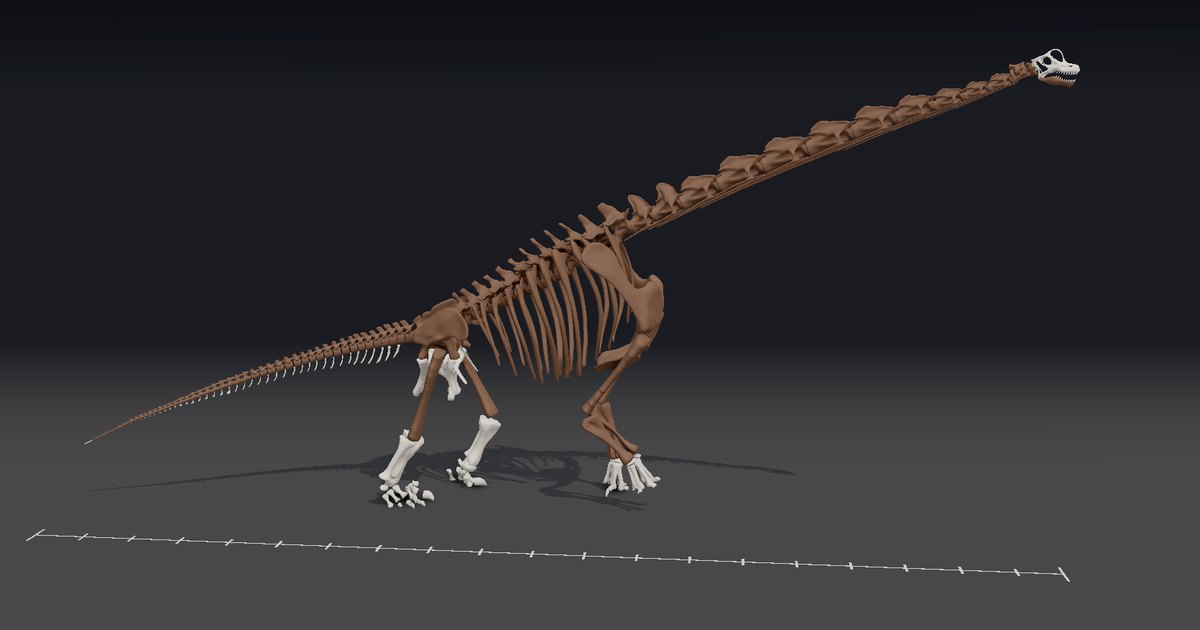
Brachiosaurus altithorax
- Age
- Jurassic, about 148.9 million years ago
- Found in
- United States
- Length
- 19.8 m
- Height
- 11.3 m
- Estimated mass
- about 57.7 t
- Group
- A close relative of Brachiosaurus
How this 3D skeleton was made
This 3D model is a reconstruction. Most bone shapes (243 of 247) are borrowed from close relatives and fitted to this species' size and body proportions. The bone shapes are not the actual shapes of this species' fossils. 4 bones were shaped from photos or figures of this species' own fossils.
From this species 4Borrowed from relatives 243Estimated 0
Bones known from fossils
130 of 247 bones are known from fossils. 117 are missing and filled in.
Known 130Filled in 117No record 0
Tap a bone on the 3D page to see where each bone shape came from.
Sources
- 3D Skeleton: Bone shapes were borrowed from the "Giraffatitan" model (S4b). Since there are no direct measurements of body part lengths for this species, its size was determined from the 2030 mm femur of one specimen (FMNH P 25107) in the table by Benson et al. (2018); the humerus was matched to the bone length of the same specimen, while the proportions of the rest of the body remain as in the model. Reason for choosing "Giraffatitan" instead of the group classification in the list (MacronariaBasal): because it is a relative of Brachiosaurus, Pond's Giraffatitan 3D model was used bone by bone (2026-09-26). The individual bone shapes are not from this species, but from the model species. Source of the model skeleton: 3D Skeleton: The Giraffatitan model from Sellers & Pond (2015) Kinect controlled dinosaur simulations, figshare doi:10.6084/m9.figshare.2008977 (CC BY 4.0) was separated into individual bones and named on this site (2026-09-26; before that, it was a scaled skeleton of the "Camarasaurus" model). Original pose (2026-09-30): Referencing the left and right foot placement in Fig. 10 of Sellers et al. 2013 PLOS ONE (Argentinosaurus), a walking pose was estimated with the long neck stretched diagonally forward and the right front foot lifted. Stride length, joint angles, neck and head orientation, and lateral tail swing are estimates for display fitted to this model, not a reproduction of measured movement or speed for this species. Fine adjustments of joint angles to maintain ground contact and bone connections are also estimates. Rather than an illustration of this species walking, bone orientations were applied from illustrations of related species with the same walking style.
- Known bones: Sauropodomorph bone table from Cashmore et al. (2020) (the maximum value per bone from preservation scores of 0 to 1 across 12 specimens). Any bone with even a partial trace is colored as "known." Because vertebrae are scored by section (neck, back, hips, and tail), bones within the same section share the same color.
More fossils & 3D skeletons
TyrannosaurusTriceratopsMosasaurusSpinosaurusPteranodonStegosaurusGiganotosaurusArchaeopteryxAnkylosaurusTherizinosaurusAllosaurusBaryonyxVelociraptorDeinonychusParasaurolophusPachycephalosaurusCarnotaurusQuetzalcoatlusDeinosuchusYutyrannusBrontosaurusOviraptorCeratosaurusIguanodonPlesiosaurusArgentinosaurusDiplodocusIchthyosaurusDilophosaurusFutabasaurusDimetrodonFukuiraptorSarcosuchusElasmosaurusEdmontosaurusFukuisaurusKamuysaurusMicroraptorCompsognathusApatosaurusRhamphorhynchusMamenchisaurusDeinocheirusLiopleurodonKronosaurusGallimimusProtoceratopsEoraptorHeterodontosaurus