Dinosaur fossils & 3D skeletons › Spinosaurus
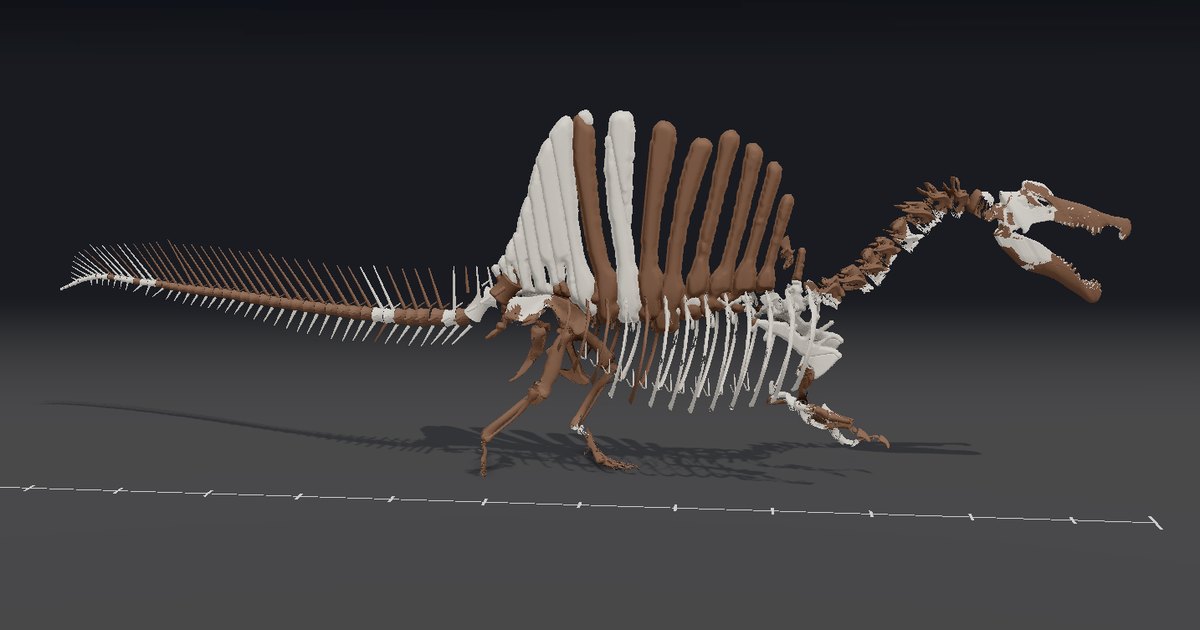
Spinosaurus Fossil & 3D Skeleton
Spinosaurus aegyptiacus
- Age
- Cretaceous, about 97.2 million years ago
- Found in
- Egypt
- Length
- 12.6 m
- Height
- 4.5 m
- Estimated mass
- about 7.4 t
- Group
- Spinosaurids
How this 3D skeleton was made
76% of bone shapes (177 of 234) were built from photos or figures of this species' own fossils; the rest are 28 borrowed from close relatives and 29 estimated.
From this species 177Borrowed from relatives 28Estimated 29
Bones known from fossils
86 of 234 bones are known from fossils. 148 are missing and filled in.
Known 86Filled in 148No record 0
Tap a bone on the 3D page to see where each bone shape came from.
Sources
- 3D Skeleton: Created on this site. Individual bones were traced from Sereno et al. 2022 eLife (CC BY 4.0) Fig. 1 A ("Digital skeletal reconstruction in lateral view (left lateral view, with 1 m scale bar)"), and thickness was added to the lateral outlines (thickness and lateral spacing are estimated). Ribs, gastralia (belly ribs), and pubic bones could not be isolated due to overlap in the figure, so their shapes were estimated. Pose (2026-09-30): Referencing the foot placement in Pacheco et al. 2019 PeerJ Fig. 1H (Gnathovorax), we estimated a pose stepping forward on short hindlimbs with the neck lowered as if peering into the water. Stride length, joint angles, neck and head orientation, and lateral tail swing are estimates tailored to this model for display, not a reconstruction of measured locomotion or speed for this species. An additional torso pitch of 4 degrees (positive is pitched forward/downward) is also an estimate. The strong downward tilt of the input skeleton's head was corrected by rotating the entire head at the tip of the neck. The 52-degree head correction angle does not represent physiological joint range of motion, but rather an adjustment amount relative to the input pose (estimated). Fine joint angle adjustments to maintain ground contact and skeletal articulation are also estimated. The slight tilting of the entire torso to match hip joint articulation while keeping both feet on the ground is also an estimate. A few centimeters of repositioning of the neck and head together to match the base of the neck is also an estimate. Rather than a walking diagram of this exact species, the bone orientations were adapted from a diagram of a relative sharing the same gait.
- Bones found: Color-coded as in the diagram (bones from the holotype, neotype, and other specimens are colored, while unfound bones are gray). Where 1 bone has both colored and gray sections, the parts were also split into 2. The skeleton in the paper combines multiple specimens scaled to match in size.
More fossils & 3D skeletons
TyrannosaurusTriceratopsMosasaurusPteranodonStegosaurusBrachiosaurusGiganotosaurusArchaeopteryxAnkylosaurusTherizinosaurusAllosaurusBaryonyxVelociraptorDeinonychusParasaurolophusPachycephalosaurusCarnotaurusQuetzalcoatlusDeinosuchusYutyrannusBrontosaurusOviraptorCeratosaurusIguanodonPlesiosaurusArgentinosaurusDiplodocusIchthyosaurusDilophosaurusFutabasaurusDimetrodonFukuiraptorSarcosuchusElasmosaurusEdmontosaurusFukuisaurusKamuysaurusMicroraptorCompsognathusApatosaurusRhamphorhynchusMamenchisaurusDeinocheirusLiopleurodonKronosaurusGallimimusProtoceratopsEoraptorHeterodontosaurus