Dinosaur fossils & 3D skeletons › Fukuisaurus
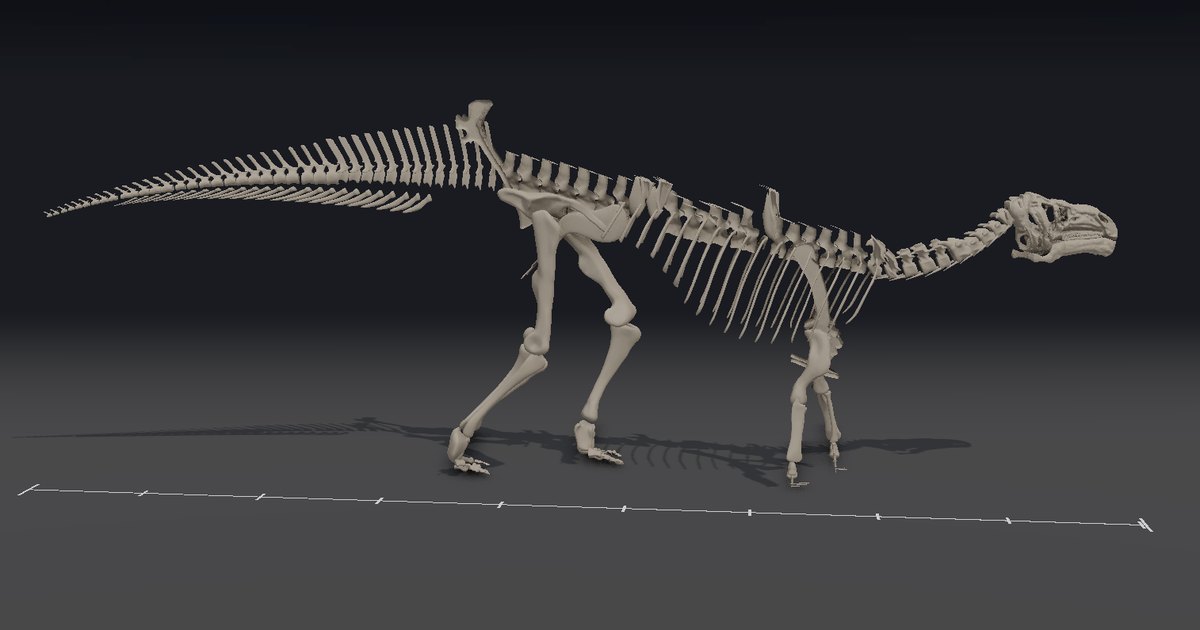
Fukuisaurus Fossil & 3D Skeleton
Fukuisaurus tetoriensis
- Age
- Cretaceous, about 117.3 million years ago
- Found in
- Japan
- Length
- 4.5 m
- Height
- 2.1 m
- Group
- Iguanodontians
How this 3D skeleton was made
This 3D model is a reconstruction. Most bone shapes (149 of 232) are borrowed from close relatives and fitted to this species' size and body proportions. The bone shapes are not the actual shapes of this species' fossils. 83 are estimated.
From this species 0Borrowed from relatives 149Estimated 83
Bones known from fossils
There is no record yet of which bones are known from fossils.
Tap a bone on the 3D page to see where each bone shape came from.
Sources
- 3D Skeleton: Borrowed bone shapes from the template "Ouranosaurus" (O6). [Size is inferred] No bone length records could be found for this species (few fossils have been discovered). The size was scaled to match the widely cited body length estimate of 4.5 m (Source: Paul 2010; from the English Wikipedia article "Fukuisaurus"). The rest of the body proportions remain as in the template. Weak point of the template's pose: On 2026-09-26, the tail was changed from sloping down to the ground to being held nearly horizontal (modern consensus). The forelimbs remain raised off the ground as in the template. The individual bone shapes are not from this species, but from the template species. Unique features belonging only to the template species (the back sail) were removed. Source of the template skeleton: 3D Skeleton: Created on this site. Bone shapes were traced from outlines in photos of bones from Venice specimen MSNVE 3714, and scaled to the attached measurement table and figure scale bars in the same paper (Bertozzo et al. 2017 PeerJ, CC BY 4.0). The 17 neural spine bones of the back sail were individually segmented from lateral photos of the mounted skeleton. As the skull of this specimen is a cast, the skull was taken from the whole-body line drawing in the same paper (drawn from Taquet 1976 Pose (2026-09-30): Bone orientations were applied directly from approximate angles visually read from Fig. 2A (Magnapaulia full skeletal diagram in a walking pose) in Prieto-Márquez et al. 2012 PLOS ONE (CC BY) (hindlimbs: leading leg femur 34° forward, shin 23° backward, metatarsus 16° forward; trailing leg femur 4° backward, shin 45° backward, metatarsus 7° backward / forelimbs: leading leg humerus 5° forward, forearm 16° forward; trailing leg humerus 15° backward, forearm 3° backward). Previously, this was softened by 2/3 as a museum standing pose. For species whose front limbs do not reach the ground, the body excluding the hind legs was tilted forward around the hips to make them touch. Rather than a walking diagram of this species itself, bone orientations from a relative sharing the same gait were applied. The neck was turned slightly to the side, and the tail was bent laterally (angles are estimates; the diagram was lateral-only).
- A per-bone table for ornithischians (horned, plated, and beaked dinosaurs) has not yet been found. Since there are no per-bone records, it is colored gray = unknown.
More fossils & 3D skeletons
TyrannosaurusTriceratopsMosasaurusSpinosaurusPteranodonStegosaurusBrachiosaurusGiganotosaurusArchaeopteryxAnkylosaurusTherizinosaurusAllosaurusBaryonyxVelociraptorDeinonychusParasaurolophusPachycephalosaurusCarnotaurusQuetzalcoatlusDeinosuchusYutyrannusBrontosaurusOviraptorCeratosaurusIguanodonPlesiosaurusArgentinosaurusDiplodocusIchthyosaurusDilophosaurusFutabasaurusDimetrodonFukuiraptorSarcosuchusElasmosaurusEdmontosaurusKamuysaurusMicroraptorCompsognathusApatosaurusRhamphorhynchusMamenchisaurusDeinocheirusLiopleurodonKronosaurusGallimimusProtoceratopsEoraptorHeterodontosaurus