Dinosaur fossils & 3D skeletons › Eoraptor
Eoraptor Fossil & 3D Skeleton
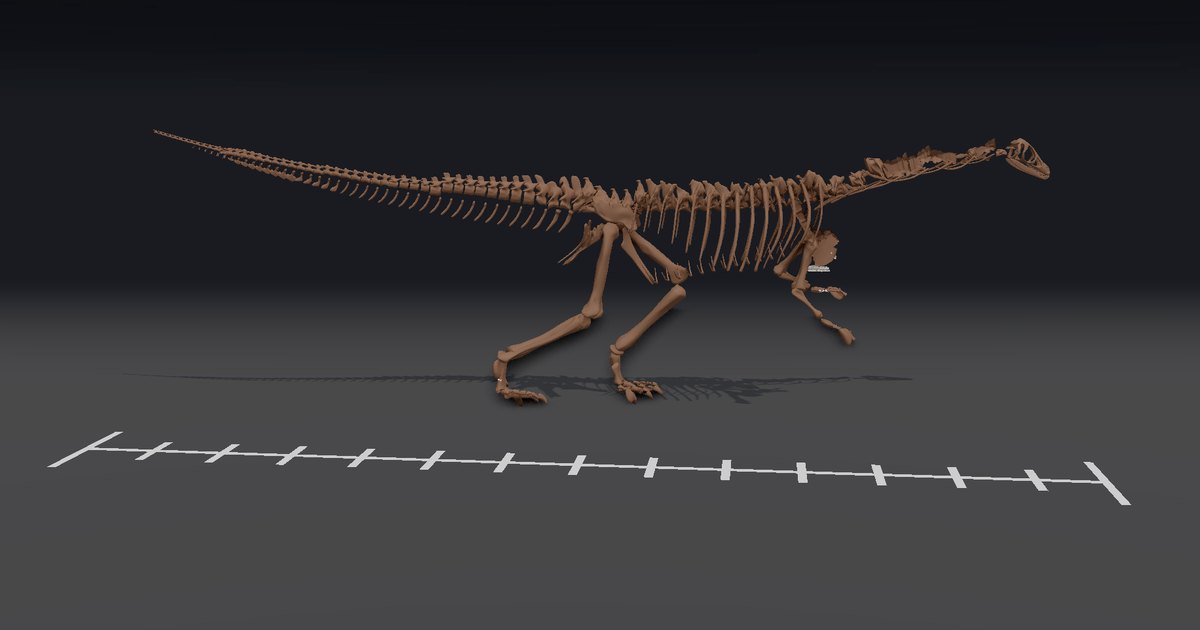
Eoraptor lunensis
- Age
- Triassic, about 230.4 million years ago
- Found in
- Argentina
- Length
- 1.4 m
- Height
- 0.5 m
- Estimated mass
- about 17 kg
- Group
- An early plesiosaur relative
How this 3D skeleton was made
This 3D model is a reconstruction. Most bone shapes (264 of 292) are borrowed from close relatives and fitted to this species' size and body proportions. The bone shapes are not the actual shapes of this species' fossils. 28 are estimated.
From this species 0Borrowed from relatives 264Estimated 28
Bones known from fossils
278 of 292 bones are known from fossils. 14 are missing and filled in.
Known 278Filled in 14No record 0
Tap a bone on the 3D page to see where each bone shape came from.
Sources
- 3D Skeleton: Bone shapes were borrowed from the template "Sarahsaurus" (S1). Since direct measurements of body parts do not exist for this species, the size was determined from the 154 mm femur of one specimen (PVSJ 512) in the table of Benson et al. (2018). The shin and humerus were matched to the bone lengths of the same specimen, while the proportions of the other body parts remain those of the template. The shapes of individual bones belong to the template species, not this species. Source of template skeleton: 3D Skeleton: Created on this site. Bone shapes were traced from outlines of bone photos (from 1–2 angles, such as lateral, dorsal, and anterior) of holotype TMM 43646-2 and others, and scaled to the measurement tables and scale bars in the same paper (Marsh & Rowe 2018 PLOS ONE, CC0). The neck and back vertebrae found articulated were separated into individual bones according to the centrum length ratios in the table. For the skull, CT scans of MCZ 8893 (tentatively referred to Sarahsaurus) were used. Pose (2026-09-30): Bone orientations were read pixel-by-pixel directly from Figure 1H (skeletal drawing of Gnathovorax in a walking pose) in Pacheco et al. 2019 PeerJ (CC BY) (front leg: femur 50 degrees forward, shin 46 degrees backward, instep 24 degrees forward; back leg: femur 12 degrees backward, shin 67 degrees backward, instep 16 degrees forward; arm: humerus 40 degrees backward, forearm 66 degrees forward). Because the drawing shows only one arm, the far arm was posed swinging slightly forward (estimated). The ground level of both soles was aligned by adjusting the angle of the back shin (or instep if needed). The lateral turn of the neck and sideways curvature of the tail are estimated (the drawing shows only a side view). Bone angles were applied not from an illustration of this species itself, but from a relative sharing the same gait. The neck is turned slightly to the side, and the tail curves sideways (angle magnitude is estimated; the drawing shows only a side view).
- Known bones: Sauropodomorph bone table from Cashmore et al. (2020) (the maximum value for each bone across 11 specimens, scored as preserved proportion 0–1). Any bone preserved even slightly is colored as "known". Because vertebrae are given as proportions by region (neck, back, hips, and tail), the bones within each region share the same color.
More fossils & 3D skeletons
TyrannosaurusTriceratopsMosasaurusSpinosaurusPteranodonStegosaurusBrachiosaurusGiganotosaurusArchaeopteryxAnkylosaurusTherizinosaurusAllosaurusBaryonyxVelociraptorDeinonychusParasaurolophusPachycephalosaurusCarnotaurusQuetzalcoatlusDeinosuchusYutyrannusBrontosaurusOviraptorCeratosaurusIguanodonPlesiosaurusArgentinosaurusDiplodocusIchthyosaurusDilophosaurusFutabasaurusDimetrodonFukuiraptorSarcosuchusElasmosaurusEdmontosaurusFukuisaurusKamuysaurusMicroraptorCompsognathusApatosaurusRhamphorhynchusMamenchisaurusDeinocheirusLiopleurodonKronosaurusGallimimusProtoceratopsHeterodontosaurus