Dinosaur fossils & 3D skeletons › Heterodontosaurus
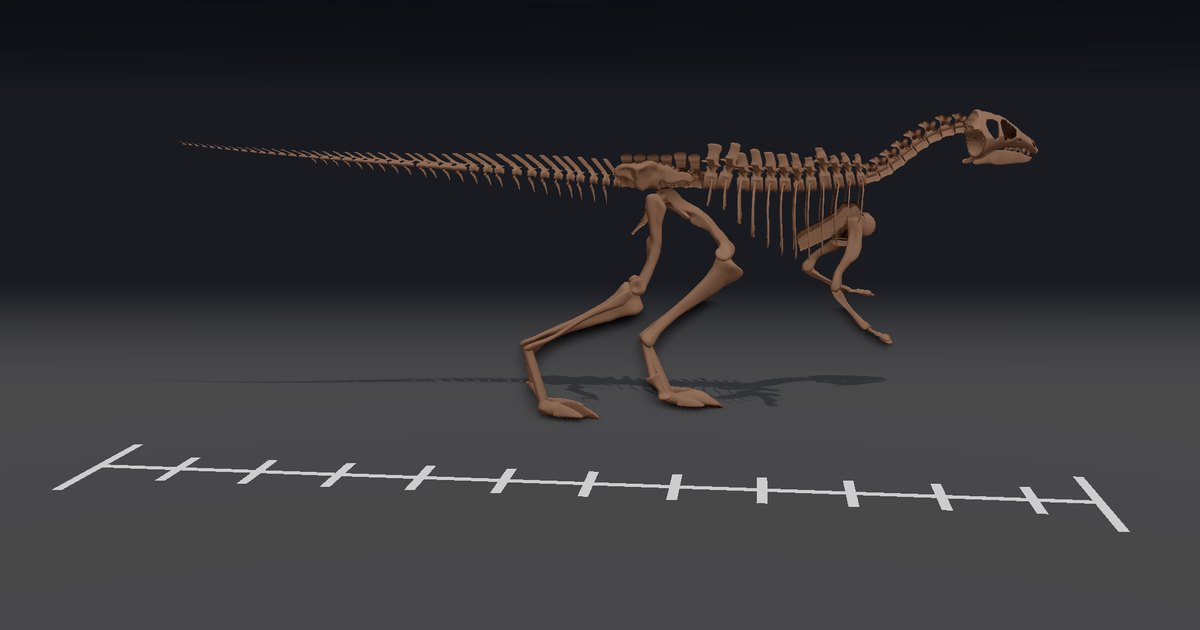
Heterodontosaurus Fossil & 3D Skeleton
Heterodontosaurus tucki
- Age
- Jurassic, about 197.2 million years ago
- Found in
- South Africa
- Length
- 1.2 m
- Height
- 0.5 m
- Group
- Heterodontosaurids
How this 3D skeleton was made
This 3D model is a reconstruction. Most bone shapes (98 of 168) are borrowed from close relatives and fitted to this species' size and body proportions. The bone shapes are not the actual shapes of this species' fossils. 70 are estimated.
From this species 0Borrowed from relatives 98Estimated 70
Bones known from fossils
168 of 168 bones are known from fossils.
Known 168Filled in 0No record 0
Tap a bone on the 3D page to see where each bone shape came from.
Sources
- 3D Skeleton: Bone shapes were borrowed from the template "Enigmacursor" (O1). Since direct measurements of body parts do not exist for this species, the size was determined from the 112 mm femur of one specimen (SAM-PK-K1332) in the table of Benson et al. (2018). The shin and humerus were matched to the bone lengths of the same specimen, while the proportions of the other body parts remain those of the template. [Size adjusted to commonly cited body length] Modeling from recorded bone lengths resulted in a total length of 0.92 m, which differed significantly from the commonly cited body length (1.18–1.75 m; 1.18 m for SAM-PK-K1332, up to 1.75 m for large skull specimens, according to the English Wikipedia article "Heterodontosaurus"). Therefore, the entire skeleton was scaled up by 1.28× to reach 1.18 m (either because the recorded specimen was a small individual, or because the template's body proportions differ from this species). The shapes of individual bones belong to the template species, not this species. Source of template skeleton: 3D Skeleton: Created on this site. Bone shapes were traced from outlines of bone photos of NHMUK PV R 39000 (Maidment & Barrett 2025 Royal Society Open Science, CC BY 4.0), and lengths were matched to Table 1 and Table 2 in the same paper. Gray areas in the photos (parts restored with plaster or similar materials at the museum) are also included in the shapes. Lengths of the head, neck, and tail were taken from the full-body reconstruction in Figure 2a of the same paper. Pose (2026-09-30): Bone orientations were read pixel-by-pixel directly from Figure 1H (skeletal drawing of Gnathovorax in a walking pose) in Pacheco et al. 2019 PeerJ (CC BY) (front leg: femur 50 degrees forward, shin 46 degrees backward, instep 24 degrees forward; back leg: femur 12 degrees backward, shin 67 degrees backward, instep 16 degrees forward; arm: humerus 40 degrees backward, forearm 66 degrees forward). Because the drawing shows only one arm, the far arm was posed swinging slightly forward (estimated). The ground level of both soles was aligned by adjusting the angle of the back shin (or instep if needed). The lateral turn of the neck and sideways curvature of the tail are estimated (the drawing shows only a side view). Bone angles were applied not from an illustration of this species itself, but from a relative sharing the same gait. The neck is turned slightly to the side, and the tail curves sideways (angle magnitude is estimated; the drawing shows only a side view).
- A per-bone table for ornithischians (horned, plated, and beaked dinosaurs) has not yet been found. Since there are no per-bone records, it is colored gray = unknown.
More fossils & 3D skeletons
TyrannosaurusTriceratopsMosasaurusSpinosaurusPteranodonStegosaurusBrachiosaurusGiganotosaurusArchaeopteryxAnkylosaurusTherizinosaurusAllosaurusBaryonyxVelociraptorDeinonychusParasaurolophusPachycephalosaurusCarnotaurusQuetzalcoatlusDeinosuchusYutyrannusBrontosaurusOviraptorCeratosaurusIguanodonPlesiosaurusArgentinosaurusDiplodocusIchthyosaurusDilophosaurusFutabasaurusDimetrodonFukuiraptorSarcosuchusElasmosaurusEdmontosaurusFukuisaurusKamuysaurusMicroraptorCompsognathusApatosaurusRhamphorhynchusMamenchisaurusDeinocheirusLiopleurodonKronosaurusGallimimusProtoceratopsEoraptor