Dinosaur fossils & 3D skeletons › Pachycephalosaurus
Pachycephalosaurus Fossil & 3D Skeleton
Pachycephalosaurus wyomingensis
- Age
- Cretaceous, about 69.1 million years ago
- Found in
- United States
- Length
- 4.5 m
- Height
- 1.6 m
- Group
- Pachycephalosaur relatives
How this 3D skeleton was made
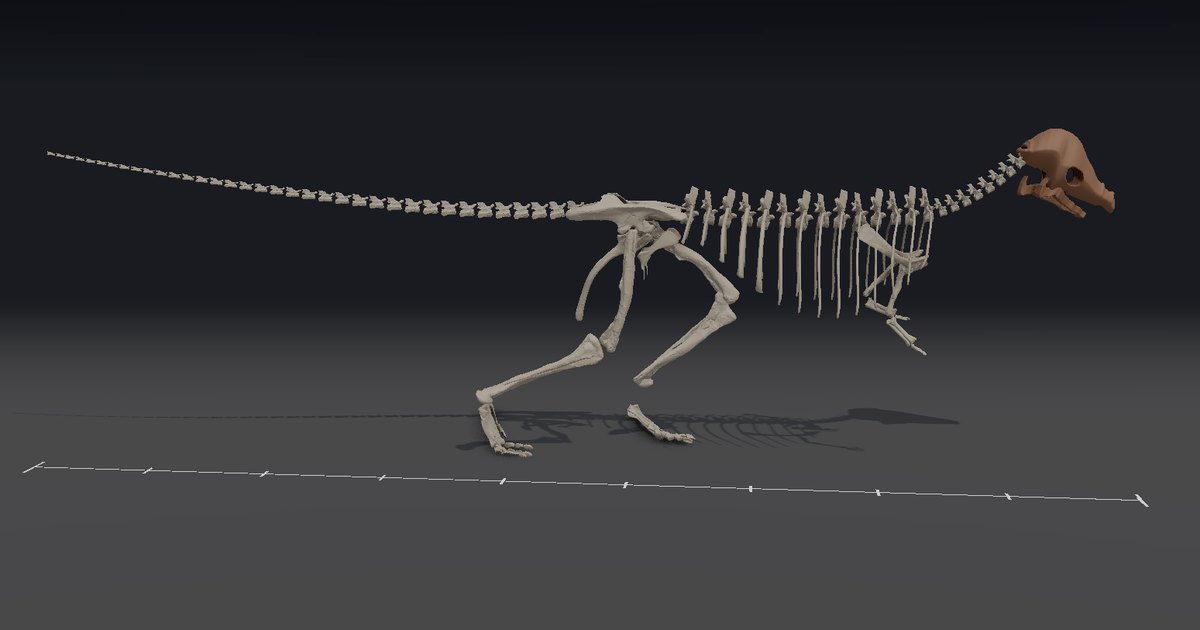
This 3D model is a reconstruction. Most bone shapes (172 of 180) are borrowed from close relatives and fitted to this species' size and body proportions. The bone shapes are not the actual shapes of this species' fossils. 8 are estimated.
From this species 0Borrowed from relatives 172Estimated 8
Bones known from fossils
2 of 180 bones are known from fossils. 178 have no record.
Known 2Filled in 0No record 178
Tap a bone on the 3D page to see where each bone shape came from.
Sources
- 3D skeleton: Borrowed bone shapes from the template 'Stegoceras' (O8). Because this species lacks measured body part lengths, its size was determined from the 441 mm femur of one specimen (Triebold specimen cast) in the table of Benson et al. (2018), keeping the proportions of other body parts from the template. [Scaled to match widely cited body length] Reconstructing it from recorded bone lengths resulted in a total length of 3.56 m, which differed significantly from the widely cited body length (4.5–4.5 m; no source cited in the article; taken from the English Wikipedia article 'Pachycephalosaurus'), so the entire skeleton was scaled up by 1.26 to match 4.5 m (either because the recorded specimen was a small individual, or because the template's proportions differ from this species). The shapes of individual bones are not from this species, but from the template species. Source of template skeleton: 3D skeleton: Assembled on this site. Bone shapes for the limbs, pelvis, back, and tail directly use the supplementary 3D data from Moore et al. 2022 PLOS ONE (CC BY 4.0) (bones of specimen UALVP 2 assembled into an articulated pose by the authors), and the pelvis was placed in the authors' articulated arrangement (hindlimb posture was changed to a walking pose under 'Posture (2026-09-30)' below). Because the 3D data lacks units, the femur was scaled to 225 mm (table in Benson et al. 2018), and for the forelimb, the humerus was 0.3 times the femur Posture (2026-09-30): Used bone orientations directly read in pixels from Pacheco et al. 2019 PeerJ (CC BY) Fig. 1H (skeletal diagram of Gnathovorax in a walking pose) (front leg: femur 50° forward, shin 46° backward, instep 24° forward; back leg: femur 12° backward, shin 67° backward, instep 16° forward; arm: humerus 40° backward, forearm 66° forward). Since the figure shows only one arm, the far arm was swung slightly forward (estimated). The heights of the soles of both feet were leveled by adjusting the angle of the back leg's shin (and instep if needed). The sideways turn of the neck and sideways curve of the tail are estimated (the figure only shows a side view). Bone orientations were taken not from a walking diagram of this species itself, but from a relative with the same walking style. The neck was turned slightly to the side, and the tail was curved sideways (magnitude of angle is estimated; the figure is side view only).
- A per-bone table for ornithischians (horned, plated, and beaked dinosaurs) has not yet been found. Since there are no per-bone records, it is colored gray = unknown.
More fossils & 3D skeletons
TyrannosaurusTriceratopsMosasaurusSpinosaurusPteranodonStegosaurusBrachiosaurusGiganotosaurusArchaeopteryxAnkylosaurusTherizinosaurusAllosaurusBaryonyxVelociraptorDeinonychusParasaurolophusCarnotaurusQuetzalcoatlusDeinosuchusYutyrannusBrontosaurusOviraptorCeratosaurusIguanodonPlesiosaurusArgentinosaurusDiplodocusIchthyosaurusDilophosaurusFutabasaurusDimetrodonFukuiraptorSarcosuchusElasmosaurusEdmontosaurusFukuisaurusKamuysaurusMicroraptorCompsognathusApatosaurusRhamphorhynchusMamenchisaurusDeinocheirusLiopleurodonKronosaurusGallimimusProtoceratopsEoraptorHeterodontosaurus