Dinosaur fossils & 3D skeletons › Ankylosaurus
Ankylosaurus Fossil & 3D Skeleton
Ankylosaurus magniventris
- Age
- Cretaceous, about 69.1 million years ago
- Found in
- United States
- Length
- 6.0 m
- Height
- 1.9 m
- Estimated mass
- about 4.8 t
- Group
- Ankylosaurus relatives
How this 3D skeleton was made
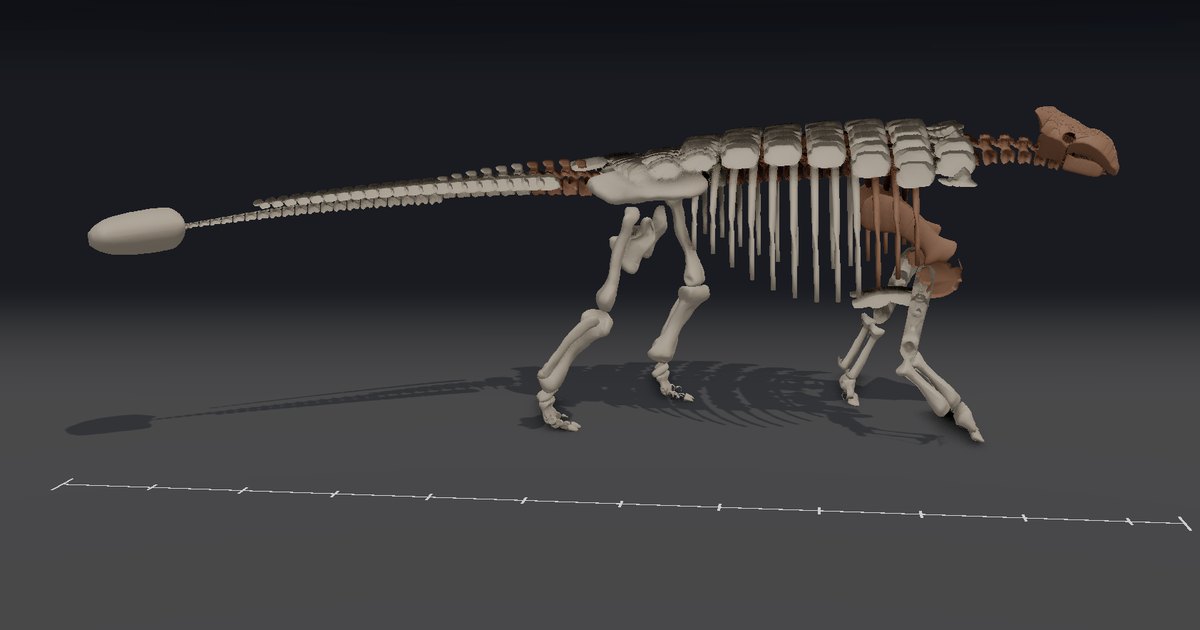
This 3D model is a reconstruction. Most bone shapes (170 of 310) are borrowed from close relatives and fitted to this species' size and body proportions. The bone shapes are not the actual shapes of this species' fossils. 4 bones were shaped from photos or figures of this species' own fossils. 136 are estimated.
From this species 4Borrowed from relatives 170Estimated 136
Bones known from fossils
35 of 310 bones are known from fossils. 275 have no record.
Known 35Filled in 0No record 275
Tap a bone on the 3D page to see where each bone shape came from.
Sources
- 3D Skeleton: Bone shapes were borrowed from the "Europelta" model (O4). Since there are no direct measurements of body part lengths for this species, its size was determined from the 660 mm femur of one specimen (AMNH 5214) in the table by Benson et al. (2018); the humerus was matched to the bone length of the same specimen, while the proportions of the rest of the body remain as in the model. The individual bone shapes are not from this species, but from the model species. Source of the model skeleton: 3D Skeleton: Created on this site. Bone shapes were traced from outlines in bone photographs of two specimens (holotype AR-1/10 and AR-1/31) (Kirkland et al. 2013 PLOS ONE, CC BY 4.0), and sizes were matched to scale bars in figures and measurement tables (femur 502.9 mm, tibia 458.8 mm; vertebra height matches the table). The skull is from the reconstruction of the skull in the same paper. For armor plates, shapes from photographs of recovered plates were based on the paper's whole-body diagram (Fig. 33 Pose (2026-09-30): Referencing the left and right foot placement in Fig. 33A of Kirkland et al. 2013 PLOS ONE (Europelta), a low shifting step with the tail club held to the side was estimated. Stride length, joint angles, neck and head orientation, and lateral tail swing are estimates for display fitted to this model, not a reproduction of measured movement or speed for this species. Referencing Arbour 2009 PLOS ONE e6738, the stiff handle and club at the tail tip move as a single unit, swung laterally from the base. The swing arc is an estimate. Fine adjustments of joint angles to maintain ground contact and bone connections are also estimates. Matching the angles of the femur and shin to maintain foot contact and closing the hip joint gap are also model-based estimates. A slight positional adjustment of the right femur is also an estimate to maintain the spacing between hip and knee without changing bone shapes. Rather than an illustration of this species walking, bone orientations were applied from illustrations of related species with the same walking style.
- A per-bone table for ornithischians (horned, plated, and beaked dinosaurs) has not yet been found. Since there are no per-bone records, it is colored gray = unknown.
More fossils & 3D skeletons
TyrannosaurusTriceratopsMosasaurusSpinosaurusPteranodonStegosaurusBrachiosaurusGiganotosaurusArchaeopteryxTherizinosaurusAllosaurusBaryonyxVelociraptorDeinonychusParasaurolophusPachycephalosaurusCarnotaurusQuetzalcoatlusDeinosuchusYutyrannusBrontosaurusOviraptorCeratosaurusIguanodonPlesiosaurusArgentinosaurusDiplodocusIchthyosaurusDilophosaurusFutabasaurusDimetrodonFukuiraptorSarcosuchusElasmosaurusEdmontosaurusFukuisaurusKamuysaurusMicroraptorCompsognathusApatosaurusRhamphorhynchusMamenchisaurusDeinocheirusLiopleurodonKronosaurusGallimimusProtoceratopsEoraptorHeterodontosaurus